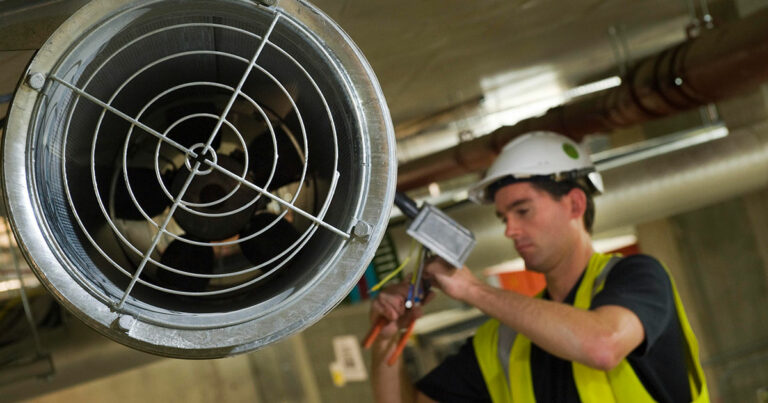

In a building fire, smoke is often the greatest threat to life. Smoke ventilation systems are designed to manage that risk, helping to keep escape routes clear, improve visibility and support firefighting operations. But these systems only work if they are properly maintained by competent specialists.
Under Article 17 of the Regulatory Reform (Fire Safety) Order 2005, Responsible Persons must ensure fire safety systems are maintained and kept in efficient working order. The challenge for many dutyholders, however, is demonstrating that this maintenance is carried out competently, consistently and to recognised industry standards.
This is where SMR 01 – the Smoke Control Service, Maintenance & Repair Certification Scheme comes in.
What SMR 01 is and who sits behind it?
SMR 01 (Smoke Control Service, Maintenance & Repair) is a structured, audited third‑party certification scheme for organisations that service, maintain and repair smoke control and smoke ventilation systems. It provides formal verification of competence and consistency through a combination of management system reviews, engineer competence assessment and live site inspections.
The scheme has been developed by IFC Certification Ltd in consultation with the Smoke Control Association, and it sits within Kiwa’s wider Service, Maintenance & Repair (SMR) framework. Kiwa’s description of the broader SMR framework is revealing: it was created because ongoing maintenance has historically been “less structured and inconsistently verified” than installation, and specifically to address issues such as variable maintenance standards, inconsistent competence validation, limited independent oversight of servicing activity, and weak documentation/traceability, under a backdrop of increased scrutiny following building safety reform.
Certification is delivered under United Kingdom Accreditation Service accreditation to ISO/IEC 17065, supporting independence and audit robustness.
What SMR 01 assesses and how certification works
SMR 01 is designed to answer three questions at once: does the organisation have the right governance; are the engineers competent; and do they apply that competence correctly on real sites?
Kiwa sets out that SMR 01 verifies organisational management systems, service engineer competence and on‑site performance, covering (among other factors) system‑specific training, maintenance procedures and documentation, technical understanding, compliance with relevant standards and manufacturer requirements, quality management, and record keeping.
The certification process is intentionally practical rather than theoretical. It begins with an application and initial review, moves into an office‑based competency assessment (policies, procedures, competence records and quality controls), and then includes on‑site audits where maintenance visits are observed. If non‑conformities are found, they must be corrected within agreed timeframes before certification is granted or maintained. After certification, ongoing surveillance continues through annual audits and periodic site inspections, with the number of engineer site inspections set proportionally to the number of employed service engineers.
SMR 01 applies to maintenance of systems such as natural smoke ventilation (AOV/NSHEV), mechanical smoke extract, pressurisation systems, car park smoke control/ventilation, and smoke dampers with associated controls. It is also positioned as aligned with benchmarks including BS EN 12101, the BS 7346 series, and guidance such as Approved Document B – alongside manufacturers’ requirements.
Why SMR 01 matters for dutyholders, managing agents and procurement
SMR 01 is built for people who have to sign their name under “safe”. The scheme’s stated benefits are direct: improved life safety through competent, consistent maintenance; support for alignment with statutory expectations and key standards; reduced liability risk through auditable evidence of third‑party verified competence; and stronger credibility for tenders and frameworks.
It also fits the post‑Grenfell Tower direction of travel: more scrutiny, clearer duties, and a stronger expectation that competence is evidenced rather than assumed. The Building Safety Act 2022 created an in‑occupation regime for higher‑risk residential buildings, with Accountable Persons as the dutyholders during occupation, and statutory duties set out in Part 4 of the Act. SMR certification is framed as a way for maintenance organisations to demonstrate compliance and meet the expectations of this higher‑accountability environment.
SMR 01 quickfire questions answered
Is SMR 01 legally required?
No. SMR 01 is a voluntary certification scheme. Its purpose is to support (and evidence) the wider regulatory expectation that competence and maintenance should be demonstrable, particularly for safety‑critical systems.
Is SMR 01 just a management system audit, or does it assess engineers too?
It does both. SMR 01 assesses organisational systems and service engineer competence, including site‑based audits where engineers are observed carrying out maintenance visits.
How long does SMR 01 certification take, and what does ongoing compliance look like?
Timescales vary depending on company size and readiness; IFCC provides a structured assessment plan following application. Certification then continues through annual surveillance audits and periodic site inspections, scaled to the number of service engineers employed.
Does SMR 01 cover installers and installation work?
No – SMR 01 covers service, maintenance and repair. Installation is addressed through separate installer certification routes, including SDI 19 for smoke control installers, which the Smoke Control Association has historically required for installer members.