
Fire Alarm System Maintenance
A fire alarm system only protects people when it works exactly as it should, the moment it is needed. At FDS Maintenance, we provide planned fire alarm system maintenance for commercial, residential and mixed-use buildings, helping responsible persons keep life-safety systems reliable, documented and compliant.
For non-domestic premises, our maintenance is aligned with BS 5839-1. Where domestic premises are governed by BS 5839-6, our approach reflects that standard and the requirements of the building and system type.
In England and Wales, that work supports the wider duties of the Regulatory Reform Fire Safety Order 2005, which requires relevant fire safety equipment to be properly maintained and supported by competent persons.
Standards-led fire alarm maintenance with one provider for alarms and smoke ventilation
We maintain more than the devices you can see on the wall or ceiling. Our service can cover control and indicating equipment, smoke, heat and multi-sensor detection, manual call points, sounders, visual alarm devices, standby batteries, power supplies, alarm transmission paths, key system interfaces as well as smoke ventilation systems. Good maintenance is not just a reset and a signature. It is functional testing, early fault identification, a practical view of overall system condition, and clear records that show what was checked, what was found and what action is needed.

Certified under BAFE and LPS 1014, FDS Maintenance brings proven competence to the maintenance of fire alarm and life safety systems.
Fire Alarm Systems We Service and Maintain


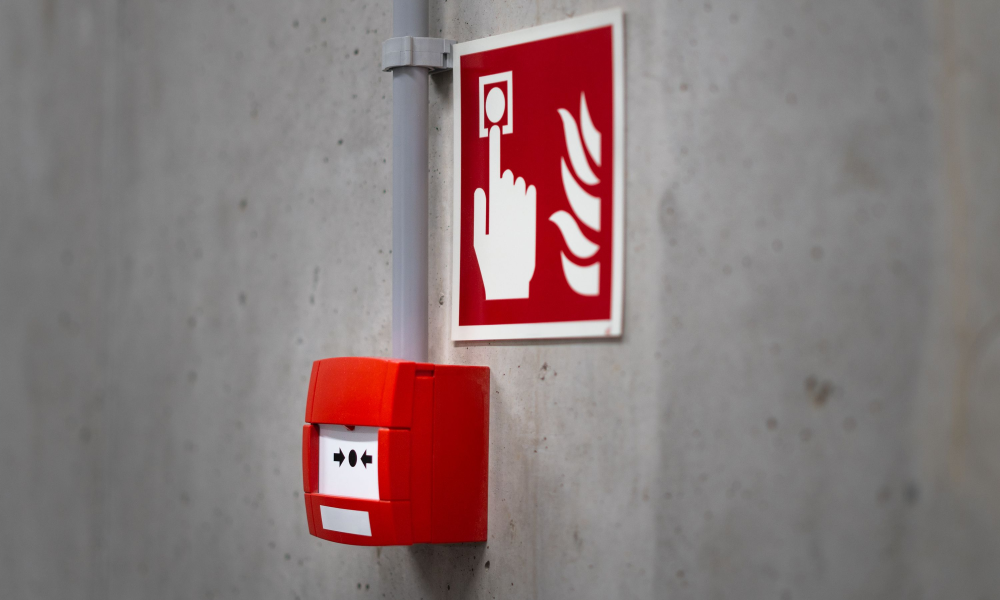
Commercial Fire Alarm Maintenance
For non-domestic systems maintained to BS 5839-1, that means regular competent-person inspection and servicing, detector testing, checks on control equipment and power supplies, and clear inspection and service documentation.
Residential Fire Alarm Maintenance
For domestic and residential systems governed by BS 5839-6, the maintenance approach should match the system grade, property type and fire strategy.
Mixed-use Fire Alarm Maintenance
In mixed-use and residential buildings, the non-domestic or communal areas can require BS 5839-1 while domestic parts are addressed under BS 5839-6, so the service must be matched to the actual building use rather than treated as one-size-fits-all.
Keep your fire alarm system compliant and ready
Why Choose FDS Maintenance?
A major benefit of choosing FDS Maintenance is that you do not need separate providers for your fire alarm system and another for your smoke ventilation system. FDS can be your maintenance partner for both fire alarms and smoke control, to which we highlight the operational value of coordinated interface testing, clearer accountability and simpler compliance records where the two systems work together.
Backed by third-party fire alarm assurance including BAFE and LPS 1014 certification, FDS Maintenance can present this service as practical, standards-led and compliance-focused from the first visit to the final report.
Frequently Asked Questions
What standards do you maintain fire alarm systems to?
For non-domestic premises, the governing maintenance standard is BS 5839-1:2025. For domestic premises, the relevant standard is BS 5839-6:2019+A1:2020. In England and Wales, those standards sit alongside the responsible person’s maintenance duties under the Regulatory Reform Fire Safety Order 2005.
How often should a commercial fire alarm be serviced?
Successive inspection and servicing visits should normally be carried out at intervals of about six months, and the 2025 revision allows a variance of one month either side. That professional servicing sits alongside weekly user testing by the premises team or nominated personnel.
What do you check during maintenance visits?
A proper maintenance visit is wider than a panel inspection. It should include detector functional testing, checks on control and indicating equipment, power supplies, manual call points, sounders, alarm transmission, service records and system documentation. Detector tests should prove that products of combustion can pass into the sensing chamber, and that service visits should result in inspection and servicing certification.
Do I still need weekly fire alarm tests if I have a maintenance contract?
Yes. guidance says weekly testing should still be carried out by premises management or chosen personnel, typically by operating a different manual call point each week, informing the alarm receiving centre where relevant, and recording the result in the logbook. A maintenance contract does not replace those routine user responsibilities.
Can you maintain fire alarms in flats, HMOs and mixed-use buildings?
Yes, but the correct maintenance basis depends on the premises and the system type. BAFE’s domestic guidance says BS 5839-6 covers domestic buildings and domestic fire alarm systems, while BAFE’s SP203-1 update notes additional domestic Grade A scope to BS 5839-6. BAFE also notes that in blocks of flats, communal parts often fall under BS 5839-1, while domestic arrangements within dwellings are addressed under BS 5839-6. That is why maintenance should always be matched to the fire strategy and actual use of the building.
Can FDS maintain my fire alarm and smoke ventilation systems under one contract?
Yes, we maintain both fire alarms and smoke ventilation systems. One competent provider improves integrated testing, reduces gaps in responsibility and simplifies compliance reporting. We are certified to BAFE, LPS 1014 and SMR 01.
Will I receive maintenance records and certificates?
Yes. The system logbook, retention of drawings and certificates, and the use of BS 5839-1 inspection and servicing certificates are critical. FDS will also provide an inspection and service certificate after each service visit.
Can maintenance help reduce false alarms?
Yes, regular servicing and maintenance is an important part of reducing false alarms, and the 2025 guidance to BS 5839-1 places greater emphasis on investigation and follow-up when false alarms occur.